


Vietnam stopped running after quantity to focus on improving the quality of rice - Cam Rice
Vietnam stopped running after quantity to focus on improving the quality of rice - Cam Rice
The project "Restructuring Vietnam's rice industry until 2025 and 2030" has just been officially approved for implementation by the Ministry of Agriculture and Rural Development. In particular, emphasis on the reduction of rice production area as well as the volume of rice for export to focus on quality.
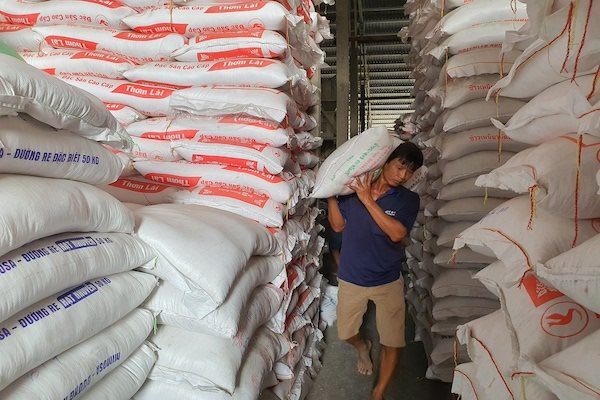
Transporting rice to the truck for consumption at Ba Dac wholesale market, Cai Be district, Tien Giang province. Photo: Trung Chanh
The decision approving the project "Restructuring Vietnam's rice industry to 2025 and 2030" has just been issued by the Ministry of Agriculture and Rural Development together with this project and officially takes effect from January 26. Last 2021.
Accordingly, the project will continue to restructure the rice industry in the direction of improving efficiency and sustainable development with the following objectives: (i) fully meet domestic consumption demand, as the core to ensure National food security (ii) improving quality, nutritional value, ensuring food hygiene and safety (iii) forming and improving the efficiency of the rice value chain (iv) adaptation and mitigation climate change (v) efficient use of natural resources and protection of the ecological environment (vi) improving farmers' incomes and benefits for consumers (vii) exporting high quality and high value rice.
The project's target to 2025 is to keep the rice area at 3.6-3.7 million hectares, equivalent to the cultivated area of 7-7.2 million hectares/year, with rice production reaching 40. -41 million tons.
The export target is 5 million tons of rice, in which, fragrant rice, specialty rice and japonica make up 40%, sticky rice 20%, high quality white rice 20%, medium and low grade rice 15% and processed products from rice is 5%; percentage of exported rice with brands over 20%.
Meanwhile, the target by 2030, keeping the rice land area is 3.5 million hectares (ie reducing 100,000-200,000 hectares compared to the target by 2025), equivalent to the cultivated area of about 7 million hectares. hectare per year, flexible cultivated area, ensuring minimum output of 35 million tons of rice / year.
The rice export target is 4 million tons (a reduction of 1 million tons compared to the target until 2025), in which, fragrant rice, specialties and japonica make 45%, sticky rice 20%, high quality white rice 15%, medium and low grade rice 10%, rice processed products 10%; rate of branded rice is 40%.
Regarding the solution of rice industry restructuring, for rice production, it will change rice land in low-efficient production areas, often affected by salinity, drought, and inundation for other agricultural purposes. high efficiency; to limit the conversion of rice land with high fertility, high yield, and complete irrigation system; end the abandonment of rice land.
Orientation for rice production in the Mekong Delta is climate change adaptation; enhancing value and efficiency through improving rice quality; expanding production - consumption links; Converting low-efficient rice land to other crops or aquaculture and increasing the area of rice rotated with aquaculture (rice- shrimp, rice-fish) or vegetables.
For the Red River Delta region, the orientation is to produce high-quality rice according to the region's consumer tastes, in which, to plan areas for local specialty rice, sticky rice, japonica; increase the application of mechanization and high technology.
In the North Central - South Central Coastal Delta region, to stabilize 2-crop rice production in regions that can actively irrigate water sources and change rice acreage in areas with difficult water sources and unstable production. to other crops; restrict rice production in areas affected by natural disasters, increase extreme weather...
As for the market development orientation, the project states that the general trend in domestic rice consumption is the demand for specialty, high quality, and organic rice as well as demand for rice for processing. increase. Therefore, production areas for domestic consumption need to have a suitable seed structure, in which, in addition to key varieties, it is necessary to exploit local specialty varieties associated with geographical indications.
With the export market, continue to implement Vietnam's rice export strategy in the period 2017-2020 and a vision to 2030; increase selection, creation and development of rice varieties to meet the structure of rice types according to the export strategy, in which, priority should be given to fragrant and special rice varieties.
To develop concentrated production areas according to varieties identified with production-consumption and export association; strictly control the production process so that the product has uniform quality and ensure the food safety and hygiene criteria, in which, absolutely meets the regulations on the maximum allowable residue level of pesticides. object (MRL), traceable; apply advanced post-harvest, preservation and processing technologies to reduce losses and ensure rice quality and flavor.
Source: https://www.thesaigontimes.vn/313333/viet-nam-ngung-chay-theo-so-luong-de-tap-trung-nang-cao-chat-luong-lua-gao.html?
Other posts

Weekly Rice Market Recap: Vietnam & Global Market Insights (W4 January 2026)
Weekly rice market update covering Vietnam and global developments, including export policies, pricing trends, and key insights for rice importers and traders.

Vietnam Rice Market Update: Mekong Delta Rice Prices Remain Stable Ahead of Lunar New Year
Vietnam rice prices today, Jan 28, remain stable across the Mekong Delta as trading activity slows ahead of the Lunar New Year. High-quality rice such as OM 18 continues to lead the market.

Vietnam to Proactively Reduce Rice Exports from 2026: What This Means for the Global Market
Vietnam plans to reduce rice exports from 2026 as part of a strategic shift toward higher value and quality.

Global Rice Price Competition in 2026: What Exporters and Buyers Need to Know
The 2026 global rice price war is reshaping export strategies and buyer decisions amid rising competition and shifting supply dynamics.

New Prospects for Low-Emission Rice and Vietnam’s Green Export Advantage
Vietnam’s low-emission rice project is reshaping the rice sector through sustainable farming, higher profits, and stronger export competitiveness. Discover how enterprises like Cam Rice are positioned to lead the next phase of green rice exports.

Vietnam’s Rice Export Prices Under Strong Year-End Pressure: Market Outlook 2025–2026
Vietnam’s rice export prices fell to 509 USD per tonne in the first nine months of 2025 as global supply increases and demand softens. Read the full market analysis and opportunities for premium rice exporters.

Vietnam Introduces Low-Emission Rice Standards Boosting Sustainable Production
Vietnam launches its first MRV process for low-emission rice, boosting sustainable production, premium quality, and export opportunities.

Vietnam’s ST25 Rice Wins World’s Best Rice 2025 | Vietnam’s Premium Rice Reinforced on the Global Stage
Vietnam’s ST25 rice wins the World’s Best Rice title for the third time, reaffirming Vietnam’s leadership in premium rice innovation and global trade.

Singapore and Vietnam Sign Rice Trade Memorandum:
Strengthening Food Security and Regional Supply Chains
Singapore and Vietnam signed their first MOC on rice trade, enhancing regional food security and opening new opportunities for Vietnamese rice exporters.

Late 2025 Update: Philippines Tightens Rice Price Controls Amid Ongoing Import Ban
The Philippines continues to enforce rice price controls while maintaining its import ban through late 2025. Retail monitoring in Metro Manila and key markets signals ongoing volatility as the government holds the 43-peso price cap.
 Call
Call Zalo
Zalo SMS
SMS Direct